Girls Weight chart in lbs for Teenagers 17 years & 1 month old
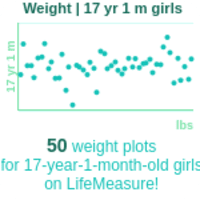
General Summary: 17 year & 1 month old girls weight
In most cases, weight measurements for 17 year & 1 month old girls will be in the range between 96 and 190 lbs. The average weight for 17 year & 1 month old girls is 122 lbs, according to the CDC and anonymized data from users.All Results
Enter your weight measurements above to see how they compare
So far, we have recorded 0 weight measurements for 17-year-1-month girls on LifeMeasure!
(chart updates daily)
Weight chart for 17 Years 1 Months girls
What does healthy weight look like for a 17 Years 1 Months?
Weight percentiles for 17 Years 1 Months girls
The weight distribution for teenage girls at 17 Years 1 Months, based on CDC growth standards:
5th percentile: 98.0 lbs
25th percentile: 110.1 lbs
50th percentile (median): 121.7 lbs
75th percentile: 137.4 lbs
95th percentile: 175.3 lbs
The percentile values on this page are displayed in lbs.
A percentile shows how their measurement compares with teenage girls of the same age and sex. Being at the 50th percentile means exactly half of teenage girls measure more and half measure less.
What to expect at 17 Years 1 Months
By 17, most girls have completed or are nearing the end of their pubertal growth phase. Weight gain in the mid-to-late teenage years reflects primarily changes in muscle mass and fat distribution rather than skeletal growth. Healthy eating patterns and regular physical activity are the most evidence-based supports for weight health in teenage girls.
Nutrition during puberty for girls
Teenage girls have higher iron requirements than boys due to menstrual blood loss. Iron deficiency is the most common nutritional deficiency in teenage girls and can affect energy, concentration, and athletic performance. Lean red meat, legumes, fortified cereals, and dark leafy vegetables are good dietary sources. Vitamin C consumed alongside iron-rich foods increases absorption.
Calcium and bone health in adolescence
Calcium and vitamin D are critical during the teenage years when approximately 40% of adult bone mass is accumulated. Girls aged 9-18 need around 1,300 mg calcium per day. Dairy products, fortified milks, leafy greens, and tinned fish with bones are reliable sources. Adequate bone density during adolescence reduces fracture risk for decades to come.
Body image and weight conversations
Weight-focused comments from peers or family are associated with increased risk of eating disorders in teenage girls. Open, non-judgemental conversations about overall health, energy, and how the body feels are a healthier approach than any weight-centred messaging. If you notice signs of disordered eating - significant food restriction, purging, or intense preoccupation with body weight - early professional support is important.
Frequently asked questions
How much should a teenager weigh?
There is a wide range of normal weight for teenagers, reflecting differences in height, body frame, puberty timing, and muscle mass. The percentile table above shows the distribution based on CDC data. Weight for teenagers is best assessed using BMI-for-age percentile rather than a standalone weight number, as height must be considered alongside weight.
Is it normal for teenagers to gain weight quickly?
Yes - rapid weight gain during puberty is entirely expected and reflects growth in both bone and muscle mass, as well as healthy increases in body fat. Girls typically gain more body fat during puberty than boys, who gain relatively more muscle. These pubertal changes are healthy and do not indicate excess weight gain if the BMI-for-age percentile remains in the normal range.
What is a healthy rate of weight gain during adolescence?
During the peak of puberty, weight gains of 4-8 kg per year are normal for both boys and girls. Outside of the pubertal growth spurt, weight gain of 2-4 kg per year is more typical. The key reference is not absolute weight but BMI-for-age percentile - a consistent position within the 5th-85th percentile range indicates healthy weight status.
Data sources and methodology
The percentile ranges on this page are drawn from CDC growth chart data from the National Center for Health Statistics and WHO Child Growth Standards (for children under 5). CDC data published May 30, 2000, with 2022 extended BMI tables. Percentiles are modelled using the LMS method (Box-Cox transformation), which accounts for the skewed distribution of measurements at each age. All measurements are given in metric units with imperial equivalents.
Individual variation is normal and expected. A healthcare provider can help interpret these measurements in context with overall health and development.
See more ages