Boys Weight chart in kgs for Teenagers 14 years & 2 months old
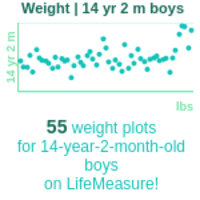
General Summary: 14 year & 2 month old boys weight
In most cases, weight measurements for 14 year & 2 month old boys will be in the range between 37 and 78 kgs. The average weight for 14 year & 2 month old boys is 52 kgs, according to the CDC and anonymized data from users.All Results
Enter your weight measurements above to see how they compare
So far, we have recorded 0 weight measurements for 14-year-2-month boys on LifeMeasure!
(chart updates daily)
Weight chart for 14 Years 2 Months boys
Understanding weight patterns for teenage boys at this stage of development.
Weight percentiles for 14 Years 2 Months boys
Growth chart data from the CDC shows weight percentiles for teenage boys at 14 Years 2 Months as follows:
5th percentile: 38.9 kg
25th percentile: 45.7 kg
50th percentile (median): 51.7 kg
75th percentile: 59.1 kg
95th percentile: 73.2 kg
The percentile values on this page are displayed in kg.
Growth chart percentiles describe where their measurement sits among teenage boys measured in the CDC reference study. At the 50th percentile, the measurement is right at the middle of the typical range.
Weight and development for teenage boys
At 14, boys may still be gaining significant muscle mass through the later stages of puberty. Weight gain in the teenage years reflects both skeletal growth and the marked increase in lean muscle mass driven by rising testosterone. Adequate dietary protein supports healthy muscle development, alongside structured resistance and aerobic exercise.
Caloric and protein needs for teenage boys
Teenage boys have higher caloric and protein needs than at any other point in their lives, driven by rapid muscle and skeletal growth. Three to four substantial meals per day, generous portions of protein-rich foods (meat, fish, eggs, legumes), and complex carbohydrates provide the energy that supports this growth phase.
Sleep and weight regulation
Adequate sleep (8-10 hours per night for teenagers) is critical not only for growth hormone secretion but for the hormonal regulation of appetite. Sleep-deprived teenagers tend to consume more calories, particularly from high-sugar and high-fat foods. Consistent sleep and wake times, even on weekends, support better sleep quality.
Physical activity for healthy weight and development
At least 60 minutes of moderate to vigorous physical activity daily is recommended through the teenage years. For boys in the pubertal growth phase, a combination of resistance training (2-3 times per week) and aerobic activity supports both muscle development and cardiovascular health.
Frequently asked questions
How much should a teenager weigh?
There is a wide range of normal weight for teenagers, reflecting differences in height, body frame, puberty timing, and muscle mass. The percentile table above shows the distribution based on CDC data. Weight for teenagers is best assessed using BMI-for-age percentile rather than a standalone weight number, as height must be considered alongside weight.
Is it normal for teenagers to gain weight quickly?
Yes - rapid weight gain during puberty is entirely expected and reflects growth in both bone and muscle mass, as well as healthy increases in body fat. Girls typically gain more body fat during puberty than boys, who gain relatively more muscle. These pubertal changes are healthy and do not indicate excess weight gain if the BMI-for-age percentile remains in the normal range.
What is a healthy rate of weight gain during adolescence?
During the peak of puberty, weight gains of 4-8 kg per year are normal for both boys and girls. Outside of the pubertal growth spurt, weight gain of 2-4 kg per year is more typical. The key reference is not absolute weight but BMI-for-age percentile - a consistent position within the 5th-85th percentile range indicates healthy weight status.
Data sources and methodology
The percentile ranges on this page are drawn from CDC growth chart data from the National Center for Health Statistics and WHO Child Growth Standards (for children under 5). CDC data published May 30, 2000, with 2022 extended BMI tables. Percentiles are modelled using the LMS method (Box-Cox transformation), which accounts for the skewed distribution of measurements at each age. All measurements are given in metric units with imperial equivalents.
Growth charts are screening tools, not diagnostic ones. If you have concerns about their measurements, a GP or paediatrician is the right first step.
See more ages