Boys Weight chart in kgs for Toddlers 14 month old
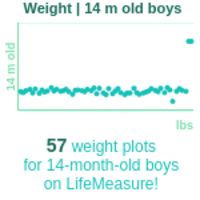
General Summary: 14 month old boys weight
In most cases, weight measurements for 14 month old boys will be in the range between 8 and 12 kgs. The average weight for 14 month old boys is 10 kgs, according to the CDC and anonymized data from users.All Results
Enter your weight measurements above to see how they compare
So far, we have recorded 0 weight measurements for 14-month-old boys on LifeMeasure!
(chart updates daily)
Weight chart for 14-Month-Old boys
Understanding weight patterns for toddler boys at this stage of development.
Weight percentiles for 14-Month-Old boys
Growth chart data from the CDC shows weight percentiles for toddler boys at 14-Month-Old as follows:
5th percentile: 9.0 kg
25th percentile: 10.0 kg
50th percentile (median): 10.7 kg
75th percentile: 11.6 kg
95th percentile: 12.9 kg
The percentile values on this page are displayed in kg.
A percentile ranking tells you where your child's measurement falls among toddler boys of the same age. The 50th percentile is the statistical midpoint of the population.
Weight and development for toddler boys
During the second year of life, weight gain slows noticeably compared to the first year, which can concern some parents. Toddlers are typically gaining around 1-2 kg over the entire second year, compared with 6-7 kg in the first. This slowdown is entirely normal and reflects increasing physical activity and a maturing metabolism.
Toddler appetite and growth slowdown
Many parents are surprised by the apparent reduction in appetite in the second year compared with infancy. This is normal: growth has slowed significantly and caloric needs per kilogram of body weight are lower than in the first year. A toddler who was eating well at 8 months and suddenly seems less interested in food at 14 months is following a normal pattern.
A healthy approach to toddler feeding
Offering a variety of foods without pressure, eating together as a family, and avoiding using food as reward or punishment supports healthy eating patterns that will serve the child well long-term. Repeated exposure to a new food - typically 10-15 exposures - is the most evidence-based way to increase acceptance of unfamiliar foods in toddlerhood.
Frequently asked questions
Should I be concerned if my child's weight has stayed the same for a few months?
Brief weight plateaus are common in growing children and are usually not a cause for concern if the child appears healthy, has a good energy level, and is growing in height. A plateau of 3 months or more, particularly if accompanied by any health concerns or a fall across percentile lines, is worth discussing at the next GP or child health check.
What is a healthy weight for this age?
The percentile table on this page shows the full range of typical weights. All values from the 5th to the 95th percentile are within normal limits. Weight at a single point in time is less informative than a consistent growth pattern - a child who has always been at the 25th percentile and remains there is growing normally.
How much weight does a child gain per year?
After infancy, the rate of weight gain slows considerably. Toddlers typically gain 1.5-2 kg per year, preschoolers around 2 kg per year, and school-age children 3-5 kg per year. During puberty, the rate accelerates significantly - 4-8 kg per year is common during the peak growth phase.
Data sources and methodology
The percentile ranges on this page are drawn from CDC growth chart data from the National Center for Health Statistics and WHO Child Growth Standards (for children under 5). CDC data published May 30, 2000, with 2022 extended BMI tables. Percentiles are modelled using the LMS method (Box-Cox transformation), which accounts for the skewed distribution of measurements at each age. All measurements are given in metric units with imperial equivalents.
Growth charts are screening tools, not diagnostic ones. If you have concerns about your child's measurements, a GP or paediatrician is the right first step.
See more ages