Boys Weight chart in kgs for babies 11 month old baby
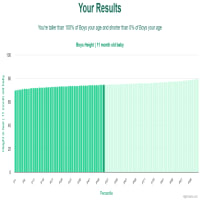
General Summary: 11 month old baby boys weight
In most cases, weight measurements for 11 month old baby boys will be in the range between 7 and 11 kgs. The average weight for 11 month old baby boys is 10 kgs, according to the CDC and anonymized data from users.All Results
Enter your weight measurements above to see how they compare
So far, we have recorded 0 weight measurements for 11-month-old-baby boys on LifeMeasure!
(chart updates daily)
Weight chart for 11-Month-Old boys
Weight benchmarks for baby boys at 11-Month-Old, from the CDC growth charts.
Weight percentiles for 11-Month-Old boys
According to CDC growth chart data, here is how weight breaks down for baby boys at 11-Month-Old:
5th percentile: 8.2 kg
25th percentile: 9.1 kg
50th percentile (median): 9.8 kg
75th percentile: 10.6 kg
95th percentile: 11.8 kg
The percentile values on this page are displayed in kg.
Growth chart percentiles describe where your child's measurement sits among baby boys measured in the CDC reference study. At the 50th percentile, the measurement is right at the middle of the typical range.
Weight and development for baby boys
At eleven months, the transition to a more varied diet is well underway. Some babies also begin to show interest in cup feeding as the first birthday approaches.
Reading the growth chart correctly
Growth charts show a range of normal: being at the 10th percentile is just as healthy as being at the 90th, as long as growth is consistent. What matters is the pattern over time, not the absolute number. If your baby's weight crosses two percentile lines downward over a period of weeks, ask for a review at your next health check.
Signs that feeding is going well
If your baby is gaining weight consistently, producing at least 6 wet nappies per day, feeding frequently, and seeming settled after most feeds, they are almost certainly getting enough. Day-to-day variation in feeding amounts is normal. Breastfed babies may cluster feed in the evenings or during growth spurts without this indicating insufficient milk supply.
Frequently asked questions
How does breastfeeding affect weight gain?
Breastfed babies tend to gain weight more rapidly in the first 3-4 months compared to formula-fed babies, and then more slowly from 6-12 months. Growth charts derived from breastfed populations (WHO standards) may show slightly different percentile placements than older CDC charts. A healthcare provider can advise on which chart is most appropriate for your baby.
How much weight should a baby gain per week?
In the first three months, most babies gain around 150-200 grams per week. This slows to approximately 100-150 grams per week between 3-6 months, and around 70-90 grams per week from 6-12 months. These averages vary between individuals - what matters most is whether the overall trend is upward and consistent.
Is my baby gaining enough weight?
A baby who is feeding well, producing at least 6 wet nappies per day, appearing alert and content between feeds, and gaining weight consistently is almost certainly getting enough. A baby who is losing weight after the normal early dip, or who has not returned to birth weight by day 14, should be reviewed by a health professional.
Data sources and methodology
The percentile ranges on this page are drawn from CDC growth chart data from the National Center for Health Statistics and WHO Child Growth Standards (for children under 5). CDC data published May 30, 2000, with 2022 extended BMI tables. Percentiles are modelled using the LMS method (Box-Cox transformation), which accounts for the skewed distribution of measurements at each age. All measurements are given in metric units with imperial equivalents.
Growth charts are screening tools, not diagnostic ones. If you have concerns about your child's measurements, a GP or paediatrician is the right first step.
See more ages