Girls Height chart in feet for Children 12 years & 6 months old
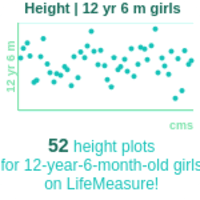
General Summary: 12 year & 6 month old girls height
In most cases, height measurements for 12 year & 6 month old girls will be in the range between 4 and 5 feet 6 inches. The average height for 12 year & 6 month old girls is 5 feet and 1 inches, according to the CDC and anonymized data from users.All Results
Enter your height measurements above to see how they compare
So far, we have recorded 0 height measurements for 12-year-6-month girls on LifeMeasure!
(chart updates daily)
Height chart for 12 Years 6 Months girls
How does their height compare with girls at this age?
Height percentiles for 12 Years 6 Months girls
Using CDC reference standards, the height percentiles for girls at 12 Years 6 Months are:
5th percentile: 4 ft 8 in
25th percentile: 4 ft 10.8 in
50th percentile (median): 5 ft 0.7 in
75th percentile: 5 ft 2.6 in
95th percentile: 5 ft 5.3 in
The percentile values on this page are displayed in feet and inches.
Growth percentiles place their measurement on a scale from 1 to 99 relative to girls. The 50th percentile represents the middle of the typical range.
What to expect at 12 Years 6 Months
Height at 12 years is closely tied to pubertal stage. Girls at this age may be mid-pubertal, with some experiencing height gains of 6-9 cm per year during the peak growth period. The timing of the growth spurt is largely genetically determined. A late-maturing child who appears shorter than peers will often catch up fully once their own growth spurt begins.
Puberty and the growth spurt
For teenage girls, the pubertal growth spurt is closely linked to the onset of menstruation. Girls who have not started their periods by age 16 should be reviewed by a GP. Adequate caloric intake is especially important during puberty - significant energy restriction can delay or slow the pubertal growth spurt and affect bone density accrual at a critical time.
Bone health during peak growth
Weight-bearing physical activity such as running, gymnastics, and dancing supports healthy bone density during the years of peak bone accrual in adolescence. Calcium requirements are highest between ages 9-18 (1,300 mg per day). Vitamin D supports calcium absorption - particularly important for those with limited sun exposure.
Frequently asked questions
Why is my child shorter or taller than their classmates?
Variation in height between children of the same age reflects differences in genetics, timing of puberty, nutrition, and general health - all of which are entirely normal. Children often go through growth spurts at different times, which can widen apparent differences temporarily before other children catch up.
How much does a child grow per year at this age?
Most school-age children grow approximately 5-6 cm per year between ages 5 and 10. During puberty, the growth rate accelerates to 7-10 cm per year at the peak of the spurt before slowing again. A growth rate below 4 cm per year in a school-age child outside of puberty is worth discussing with a GP.
What is a normal height for this age?
The percentile table on this page shows the full range of typical heights. All values from the 5th to the 95th percentile are considered within normal limits. Height at a single point in time is less informative than a consistent pattern of growth over months and years.
Data sources and methodology
The percentile ranges on this page are drawn from CDC growth chart data from the National Center for Health Statistics and WHO Child Growth Standards (for children under 5). CDC data published May 30, 2000, with 2022 extended BMI tables. Percentiles are modelled using the LMS method (Box-Cox transformation), which accounts for the skewed distribution of measurements at each age. All measurements are given in metric units with imperial equivalents.
These percentile ranges provide a population-level reference. A paediatrician or family doctor can give context specific to the individual's own growth trajectory.
See more ages