Boys Height chart in feet for babies 6 month old baby
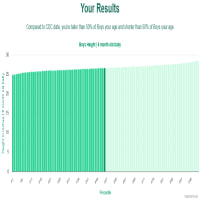
General Summary: 6 month old baby boys height
In most cases, height measurements for 6 month old baby boys will be in the range between 2 and 2 feet 3 inches. The average height for 6 month old baby boys is 2 feet and 2 inches, according to the CDC and anonymized data from users.All Results
Enter your height measurements above to see how they compare
So far, we have recorded 0 height measurements for 6-month-old-baby boys on LifeMeasure!
(chart updates daily)
Height chart for 6-Month-Old boys
Is your child's height tracking within the expected range for 6-Month-Old?
Height percentiles for 6-Month-Old boys
Based on CDC and WHO reference data, height percentiles for baby boys at 6-Month-Old are:
5th percentile: 2 ft 0.5 in
25th percentile: 2 ft 1.4 in
50th percentile (median): 2 ft 2 in
75th percentile: 2 ft 2.7 in
95th percentile: 2 ft 3.9 in
The percentile values on this page are displayed in feet and inches.
A percentile ranking tells you where your child's measurement falls among baby boys of the same age. The 50th percentile is the statistical midpoint of the population.
Height and development for baby boys
At six months, length is typically around 65-68 cm for boys and 63-66 cm for girls. This milestone is reviewed at the six-month health check.
How to measure at home
At every health check, your baby's length, weight, and head circumference are plotted on the growth chart. If you are measuring at home between checks, use a firm surface and a non-stretch tape measure, and have the same person measure each time for consistency. Measure in the morning if possible, when the body is at its maximum length before the day's activity causes minor compression.
Reading the growth chart
What matters most is not where the measurement falls on any single day, but whether your baby is following a consistent channel over time. Growth is rarely perfectly smooth - there will be brief plateaus and bursts. If your baby's length crosses two percentile lines over several weeks in either direction, ask for a review at your next health check.
Frequently asked questions
How is infant length measured?
Infant length is measured using a measuring board (infantometer) with the baby lying flat, head touching a fixed plate and legs fully extended. Two people are needed for an accurate measurement. Home measurements using a tape measure on a flat surface are less accurate but useful for tracking trends.
What is a normal height for a baby at this age?
Normal height for babies covers a wide range. The percentile table above shows the spread from the 5th to 95th percentile - all values within this range are considered within normal limits. Being at the 10th percentile is entirely healthy if growth is consistent over time.
Does height at this age predict adult height?
Early infant length has only a modest correlation with final adult height. Genetics is the strongest predictor of eventual height, but the intrauterine environment, birth order, and early nutrition also play a role. Most children settle into their genetically determined percentile channel by age 2-3.
Data sources and methodology
The percentile ranges on this page are drawn from CDC growth chart data from the National Center for Health Statistics and WHO Child Growth Standards (for children under 5). CDC data published May 30, 2000, with 2022 extended BMI tables. Percentiles are modelled using the LMS method (Box-Cox transformation), which accounts for the skewed distribution of measurements at each age. All measurements are given in metric units with imperial equivalents.
For personalised guidance, consult a paediatrician or healthcare provider who can assess your child's measurements in the context of their full growth history.
See more ages