Girls Head chart in cms for Toddlers 2 years old
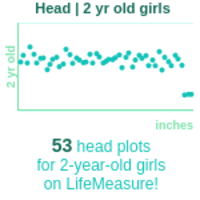
General Summary: 2 year old girls head
In most cases, head measurements for 2 year old girls will be in the range between 44 and 50 cms. The average head for 2 year old girls is 48 cms, according to the CDC and anonymized data from users.All Results
Enter your head measurements above to see how they compare
So far, we have recorded 0 head measurements for 2-year-old girls on LifeMeasure!
(chart updates daily)
Head circumference chart for 2-Year-Old girls
Reading the head circumference chart for preschool girls at 2-Year-Old.
Head circumference percentiles for 2-Year-Old girls
Using CDC reference standards, the head circumference percentiles for preschool girls at 2-Year-Old are:
5th percentile: 45.1 cm
25th percentile: 46.5 cm
50th percentile (median): 47.4 cm
75th percentile: 48.3 cm
95th percentile: 49.7 cm
The percentile values on this page are displayed in cm.
A percentile shows how your child's measurement compares with preschool girls of the same age and sex. Being at the 50th percentile means exactly half of preschool girls measure more and half measure less.
What to expect at 2-Year-Old
By age 2, the head circumference has grown dramatically from its newborn measurement, and the rate of growth is now much slower. Head circumference at this age reflects a brain that has achieved approximately 80% of its adult size. Routine head circumference measurement continues at developmental checks but is less frequent than in infancy.
Routine developmental checks
Head circumference in toddlers is measured less frequently than in infancy, typically at routine developmental checks. By age 2, the brain is approximately 80% of its adult size and the rate of head growth has slowed considerably. Continue attending all scheduled health checks, as these reviews cover development across multiple domains.
Signs that warrant review
If your toddler shows any neurological concerns - regression in speech or motor skills, unusual head shape, or significant changes in behaviour - head circumference measurement is one of several assessments a paediatrician would carry out. Early identification of any developmental concerns leads to earlier support and better outcomes.
Frequently asked questions
Is head circumference still measured after infancy?
Yes, though less frequently than in the first year. Head circumference is typically measured at developmental checks through the toddler years. By age 2, the brain is approximately 80% of its adult size, and the rate of head growth has slowed considerably. Most routine measurement of head circumference in toddlers is done to confirm normal brain development and identify any delayed closure of the fontanelle.
What does it mean if head circumference is large?
A large head circumference (above the 97th percentile, or macrocephaly) can be a normal familial trait - if one or both parents also have a large head, this is usually a benign variation. It can also reflect increased fluid around the brain (hydrocephalus) or, rarely, other conditions. A single large measurement in a healthy, developing child is not automatically cause for concern, but it should be assessed by a GP who can review family history and overall development.
What does it mean if head circumference is small?
A small head circumference (below the 3rd percentile, or microcephaly) may indicate reduced brain growth. Causes range from genetic conditions to prenatal infections or exposure to certain substances during pregnancy. Microcephaly is assessed in the context of overall development - many children with mildly small head circumferences develop entirely normally. A GP or paediatrician can assess whether further investigation is warranted.
Data sources and methodology
The percentile ranges on this page are drawn from CDC growth chart data from the National Center for Health Statistics and WHO Child Growth Standards (for children under 5). CDC data published May 30, 2000, with 2022 extended BMI tables. Percentiles are modelled using the LMS method (Box-Cox transformation), which accounts for the skewed distribution of measurements at each age. All measurements are given in metric units with imperial equivalents.
These percentile ranges provide a population-level reference. A paediatrician or family doctor can give context specific to the individual's own growth trajectory.
See more ages