Girls Head chart in inches for babies 10 week old baby
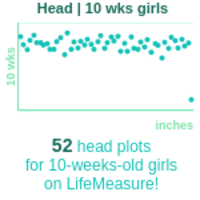
General Summary: 10 week old baby girls head
In most cases, head measurements for 10 week old baby girls will be in the range between 14 and 15 inches. The average head for 10 week old baby girls is 15 inches, according to the CDC and anonymized data from users.All Results
Enter your head measurements above to see how they compare
So far, we have recorded 0 head measurements for 10-week-old-baby girls on LifeMeasure!
(chart updates daily)
Head circumference chart for 10-Week-Old girls
What is a typical head circumference for a 10-Week-Old?
Head circumference percentiles for 10-Week-Old girls
CDC growth chart data shows the following head circumference distribution for baby girls at 10-Week-Old:
5th percentile: 14.7 in
25th percentile: 15.1 in
50th percentile (median): 15.5 in
75th percentile: 15.9 in
95th percentile: 16.5 in
The percentile values on this page are displayed in inches.
Growth percentiles place your child's measurement on a scale from 1 to 99 relative to baby girls. The 50th percentile represents the middle of the typical range.
Understanding growth at 10-Week-Old
Ten-week-old babies demonstrate a striking increase in awareness compared to the newborn period. Head circumference growth tracks the brain development underpinning this transformation.
How to measure accurately
Head circumference is measured at the widest point - just above the eyebrows at the front and around the most prominent part at the back of the skull. Use a flexible, non-stretch tape measure. Two people make the task easier: one to hold the baby's head still, one to take the reading. Healthcare professionals use a purpose-built infantometer for length; for head, a standard tape is the clinical norm.
What to watch for
The fontanelle - the soft spot at the top of the head - should feel soft and slightly sunken when the baby is calm and upright. A bulging fontanelle when the baby is not crying may warrant prompt medical attention. A persistently sunken fontanelle can indicate dehydration. Keep a record of every head measurement with the date, as trends are far more informative than a single reading.
When to seek advice
Alert your GP or health visitor if the head circumference crosses two percentile lines upward or downward over a period of weeks, if the fontanelle closes very early (before 9 months) or remains widely open after 18 months, or if you notice unusual head shape that is not resolving on its own.
Frequently asked questions
What is a normal head circumference for this age?
The percentile table on this page shows the full range of typical head circumferences. All values from the 5th to the 95th percentile are within normal limits. As with all growth measurements, the pattern of growth over time is more informative than any single reading - a baby growing consistently at the 15th percentile is growing normally.
How fast does head circumference grow in the first year?
Head circumference grows approximately 10-12 cm in the first year of life - roughly 2 cm per month in the first 3 months, slowing to about 1 cm per month from 3-6 months, and 0.5 cm per month from 6-12 months. By 12 months, the average head circumference has grown from approximately 34-35 cm at birth to around 46-47 cm.
What is the fontanelle and when does it close?
The fontanelle is the soft spot on the top of a baby's head where the skull bones have not yet fused. There are two fontanelles: the larger anterior (front) fontanelle, which typically closes between 9 and 18 months, and the smaller posterior (back) fontanelle, which usually closes by 2-3 months. Both allow the skull to expand rapidly as the brain grows during the first years of life.
Data sources and methodology
The percentile ranges on this page are drawn from CDC growth chart data from the National Center for Health Statistics and WHO Child Growth Standards (for children under 5). CDC data published May 30, 2000, with 2022 extended BMI tables. Percentiles are modelled using the LMS method (Box-Cox transformation), which accounts for the skewed distribution of measurements at each age. All measurements are given in metric units with imperial equivalents.
For any concerns about growth or development, consulting a registered health professional who has access to the full growth record is always recommended.
See more ages