Boys BMI chart in inches and lbs for Children 9 years & 6 months old
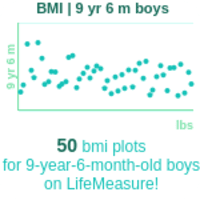
General Summary: 9 year & 6 month old boys BMI
In most cases, BMI measurements for 9 year & 6 month old boys will be in the range between 14 and 23 inches and lbs. The average BMI for 9 year & 6 month old boys is 17 inches and lbs, according to the CDC and anonymized data from users.All Results
Enter your BMI measurements above to see how they compare
So far, we have recorded 0 BMI measurements for 9-year-6-month boys on LifeMeasure!
(chart updates daily)
BMI chart for 9 Years 6 Months boys
What the BMI percentile chart shows for boys at 9 Years 6 Months.
BMI percentiles for 9 Years 6 Months boys
Growth chart data from the CDC shows BMI percentiles for boys at 9 Years 6 Months as follows:
5th percentile (underweight threshold): 14.1
25th percentile: 15.2
50th percentile (median): 16.4
75th percentile: 17.9
85th percentile (overweight threshold): 18.9
95th percentile (obesity threshold): 21.5
The percentile values on this page are displayed in inches and lbs.
The CDC classifies BMI-for-age percentiles for boys as follows: underweight below the 5th percentile, healthy weight between the 5th and 85th percentiles, overweight between the 85th and 95th percentiles, and obese above the 95th percentile.
Percentiles rank your child's measurement against a reference population of boys. The 50th percentile is the midpoint - half measure above it and half below.
BMI and development for boys
At 9 years, BMI begins to reflect early puberty effects for some children. Girls often begin puberty between ages 8 and 13, and boys between 9 and 14. A rise in BMI that precedes the pubertal growth spurt is normal and does not indicate unhealthy weight gain. The CDC BMI-for-age chart accounts for age and sex differences, making it the appropriate tool for assessing weight status in children.
What the healthy BMI range means
A healthy BMI for school-age children falls between the 5th and 85th percentile on the CDC BMI-for-age chart. Unlike adults, where a fixed range is used, children's healthy BMI values change with age and sex - which is why the age-specific percentile chart is essential.
Healthy lifestyle habits for school-age children
At least 60 minutes of moderate to vigorous physical activity daily, nine to eleven hours of sleep, regular family meals, and limited ultra-processed food intake are the most evidence-based supports for healthy BMI. Small, consistent habits over years matter far more than any short-term intervention.
Communicating about weight with children
BMI-for-age should not be discussed directly with children in terms of fat or weight. If a healthcare review reveals a concern, framing any lifestyle changes in terms of energy, strength, and overall wellbeing is more effective and less likely to contribute to body image concerns or disordered eating in later adolescence.
Frequently asked questions
What BMI percentile is considered healthy for children?
For children and teenagers, the healthy BMI range is between the 5th and 85th percentile on the CDC BMI-for-age chart. Below the 5th percentile is classified as underweight; between the 85th and 95th percentile is overweight; above the 95th percentile is obese. These classifications are screening categories used to guide further assessment, not diagnoses in themselves.
How is BMI calculated for children?
BMI is calculated using the same formula as for adults: weight (kg) divided by height (m) squared. However, for children and teenagers, the resulting number is not interpreted using adult categories. Instead, it is plotted on a sex- and age-specific percentile chart, because normal BMI values vary significantly with age during childhood and puberty.
Is a high BMI percentile always a problem for a child?
Not necessarily. A single BMI percentile reading above the 85th threshold should trigger further assessment, not alarm. Clinical evaluation considers the full growth history, body composition, diet, activity levels, and family history. Many children who screen in the overweight range on BMI have normal fat levels when properly assessed. A GP or paediatric dietitian can provide appropriate context.
Data sources and methodology
The percentile ranges on this page are drawn from CDC growth chart data from the National Center for Health Statistics and WHO Child Growth Standards (for children under 5). CDC data published May 30, 2000, with 2022 extended BMI tables. Percentiles are modelled using the LMS method (Box-Cox transformation), which accounts for the skewed distribution of measurements at each age. All measurements are given in metric units with imperial equivalents.
For personalised guidance, consult a paediatrician or healthcare provider who can assess your child's measurements in the context of their full growth history.
See more ages