Women Weight chart for Professional Adults 42 years old
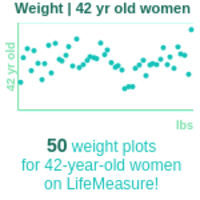
General Summary: 42 year old women weight
In most cases, weight measurements for 42 year old women will be in the range between 115 and 202 lbs. The average weight for 42 year old women is 156 lbs, according to the CDC and anonymized data from users.All Results
Enter your weight measurements above to see how they compare
So far, we have recorded 0 weight measurements for 42-year-old women on LifeMeasure!
(chart updates daily)
Weight chart for 42-Year-Old women
How does your weight compare with women at 42-Year-Old?
Weight percentiles for 42-Year-Old women
The CDC growth charts provide the following weight percentiles for women at 42-Year-Old:
5th percentile: 53.3 kg (117.5 lbs)
25th percentile: 64.6 kg (142.4 lbs)
50th percentile (median): 75.2 kg (165.8 lbs)
75th percentile: 92.1 kg (203.0 lbs)
95th percentile: 123.8 kg (272.9 lbs)
Growth percentiles place your measurement on a scale from 1 to 99 relative to women. The 50th percentile represents the middle of the typical range.
Weight and development for women
Weight tends to increase gradually through the thirties and early forties for many adults, averaging around 0.5-1 kg per year in the absence of deliberate management. At 42, weight management is increasingly about metabolic health and disease prevention. A whole-food diet, regular physical activity, adequate sleep (7-9 hours), and stress management are the evidence-based pillars of healthy weight at this life stage.
Sustainable weight management in adulthood
Maintaining a healthy weight in early and middle adulthood is primarily achieved through a balanced, whole-food diet, regular physical activity (150 minutes of moderate aerobic activity per week plus two sessions of strength training), adequate sleep, and stress management. Rapid weight gain in the thirties and forties is often linked to reduced activity rather than increased caloric intake.
Regular monitoring without obsession
Regular weight monitoring - monthly rather than daily - provides a useful trend without the anxiety of day-to-day fluctuation. Weight naturally varies by 1-2 kg depending on hydration, recent meals, and hormonal cycles. Tracking trends over weeks and months is more informative than any single measurement.
Identifying gradual weight creep early
Weight gain of 0.5-1 kg per year can accumulate significantly over a decade without feeling dramatic at any single point. Reviewing weight against the chart once or twice a year - and adjusting activity or diet slightly if an upward trend is consistent - is the most practical long-term management strategy for most adults.
Frequently asked questions
What is a healthy weight for adults at this age?
The percentile table on this page shows the distribution of weight in the reference population. However, weight alone is less informative than BMI (which accounts for height) or waist circumference (which reflects central fat distribution). For most adults, a BMI between 18.5-24.9 combined with a waist circumference below 94 cm (men) or 80 cm (women) is associated with the lowest health risk.
Why does weight tend to increase with age?
Weight gain in adulthood is driven by a gradual decline in lean muscle mass (which begins in the thirties), a corresponding fall in resting metabolic rate, and often a reduction in physical activity. Each decade of adult life, resting metabolism declines by approximately 2-3%. Compensating through regular strength training and maintaining dietary quality is more effective than caloric restriction alone.
How accurate are the weight percentiles on this page?
The weight percentile data is derived from CDC NHANES population surveys, which represent a large cross-sectional sample of adults in the United States. These figures describe what is typical in the reference population, not what is ideal from a health standpoint. The population median weight in many age groups falls in the overweight BMI range, reflecting population-level trends rather than optimal health targets.
Data sources and methodology
The percentile ranges on this page are drawn from CDC National Health and Nutrition Examination Survey (NHANES) data, Vital and Health Statistics Series 3 Number 46 (2021-2023 release), and CDC Body Measurements FastStats. Percentiles are modelled using the LMS method (Box-Cox transformation), which accounts for the skewed distribution of measurements at each age. All measurements are given in metric units with imperial equivalents.
Individual variation is normal and expected. A healthcare provider can help interpret these measurements in context with overall health and development.
See more ages