Women Height chart for Late Middle Aged Adults 62 years old
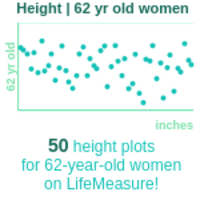
General Summary: 62 year old women height
In most cases, height measurements for 62 year old women will be in the range between 151 and 176 cms. The average height for 62 year old women is 164 cms, according to the CDC and anonymized data from users.All Results
Enter your height measurements above to see how they compare
So far, we have recorded 0 height measurements for 62-year-old women on LifeMeasure!
(chart updates daily)
Height chart for 62-Year-Old women
How does your height compare with older women at this age?
Height percentiles for 62-Year-Old women
The CDC growth charts provide the following height percentiles for older women at 62-Year-Old:
5th percentile: 149.0 cm (4 ft 10.7 in)
25th percentile: 155.6 cm (5 ft 1.3 in)
50th percentile (median): 160.4 cm (5 ft 3.1 in)
75th percentile: 165.0 cm (5 ft 5 in)
95th percentile: 171.3 cm (5 ft 7.4 in)
A percentile shows how your measurement compares with older women of the same age and sex. Being at the 50th percentile means exactly half of older women measure more and half measure less.
Height and development for older women
Between ages 60 and 75, height loss is more noticeable than in earlier decades. The cumulative effect of vertebral disc compression, reduced bone density, and postural changes can amount to 2-4 cm of height loss over the full decade. At 62, preventive strategies include weight-bearing exercise, yoga or Pilates for postural strength, adequate calcium and vitamin D, and treatment of osteoporosis where diagnosed.
Addressing midlife height loss
Height loss in middle age begins gradually in most people. The main drivers are loss of intervertebral disc height, changes in spinal curvature, and reduced bone density. Postural exercise such as yoga, Pilates, and strength training that targets the back extensors reduces functional height loss. Good posture habits at work - particularly at a desk - also make a meaningful difference over the years.
Bone density screening and calcium
Calcium requirements increase to 1,200 mg per day for women after 50 and for men after 70. Bone density screening is recommended from age 65 for women and earlier if risk factors such as corticosteroid use, early menopause, or family history of osteoporosis are present. Vitamin D supplementation is widely recommended for adults in middle age who have limited sun exposure.
Frequently asked questions
Does height change after age 25?
Adult height is essentially fixed from the mid-twenties. Very gradual height loss begins in the forties due to compression of intervertebral discs and changes in spinal posture, amounting to about 1 cm per decade initially and accelerating slightly after 60. Maintaining bone density through exercise and adequate calcium reduces this loss.
Why do older adults lose height?
Height loss in older adulthood is caused by the compression and thinning of intervertebral discs over time, reduced bone density (particularly osteoporosis), and changes in spinal curvature including kyphosis (forward rounding of the upper back). The total cumulative height loss between peak adulthood and age 80 is typically 3-6 cm for women and slightly less for men.
How can I maintain my height as I age?
The most evidence-based strategies for minimising height loss are maintaining bone density through regular weight-bearing exercise, ensuring adequate calcium and vitamin D intake, not smoking (which accelerates bone loss), treating osteoporosis if present, and practising postural exercises such as yoga or Pilates that strengthen the back extensors and deep core muscles.
Data sources and methodology
The percentile ranges on this page are drawn from CDC National Health and Nutrition Examination Survey (NHANES) data, Vital and Health Statistics Series 3 Number 46 (2021-2023 release), and CDC Body Measurements FastStats. Percentiles are modelled using the LMS method (Box-Cox transformation), which accounts for the skewed distribution of measurements at each age. All measurements are given in metric units with imperial equivalents.
Individual variation is normal and expected. A healthcare provider can help interpret these measurements in context with overall health and development.
See more ages